
What to do after water damage in your Richardson home
This list isn't in the order you'd do things by habit. It's ordered by what each step actually saves.
Call For Help(972) 449-592524/7 emergency line. Free estimates from local pros.
This list runs eight steps deep, but it isn’t chronological. It’s ranked by what each step actually saves you, starting with the move that protects the most and ending with the paperwork that matters least in the moment and most later on.
1. Shut off the water
Shut off the water at its source if you can reach it safely, or at the main if you can’t tell which fixture is failing. Nothing else on this list matters as much, since every extra minute the water runs is more square footage it reaches. This is the step that saves the most, which is exactly why it comes first.
2. Cut power near the water
If standing water has reached an outlet, a power strip, or anything still plugged in, flip the right breaker off first. Nobody wades back in until that circuit is dead, and the flip itself takes seconds. Skip this one and every step after it waits until it’s actually safe to do.
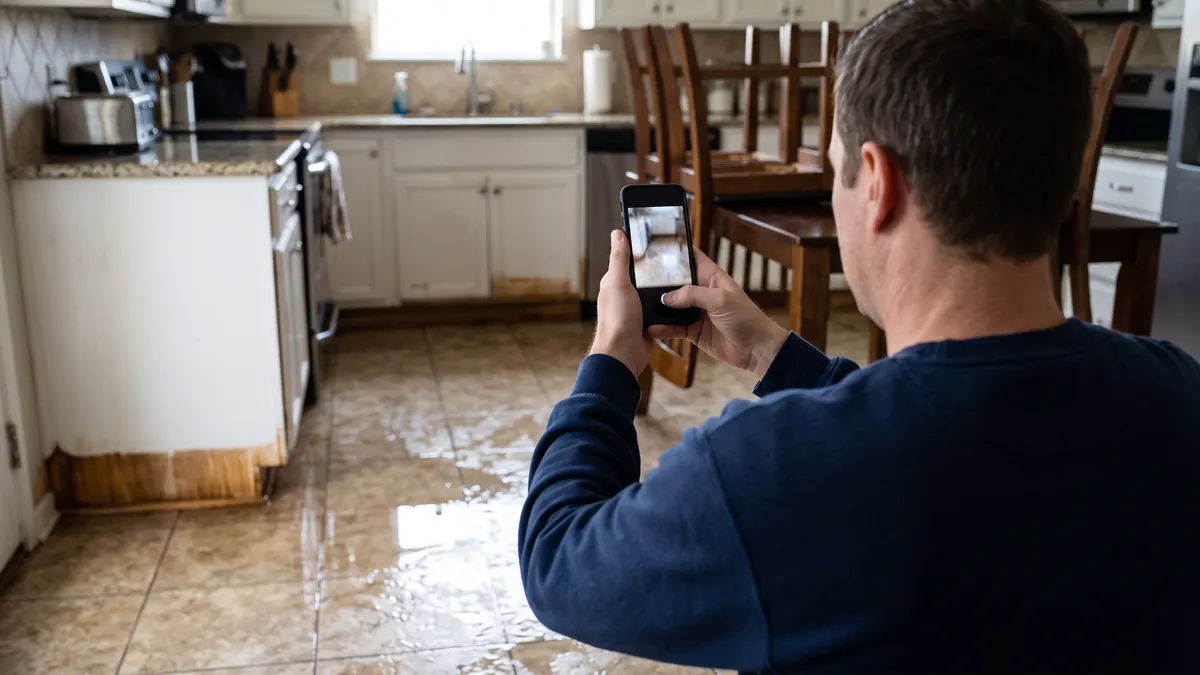
3. A phone’s camera, aimed at the room as you found it
Water starts working on everything the moment you stop looking at it, so the room in its current state is the clearest record you’ll ever get of it. A handful of photos from different angles, including whatever’s already stained or soaked, becomes the timeline an adjuster asks for later. Do this before you start deciding what to save.
4. Call your insurer
Most Texas homeowner policies expect a loss reported reasonably soon after you find it, and calling early hands your insurer more runway than waiting does. Expect a short set of questions: roughly when it started, what’s affected, and whether water’s still moving. The homeowners insurance guide is worth a look before that call if you’ve never checked what your policy actually says about water.
5. Move what’s still dry
What’s within reach and still dry enough to carry? Furniture legs, boxes on the floor, and anything electronic sitting low are worth moving to higher, drier ground before the water reaches them too. This step only protects what hasn’t been touched yet, so it matters less the longer you wait to do it.
6. Get air moving
Fans, then an open window or two if the weather allows it. Fans and airflow dry a floor’s surface fast, but they don’t reach what’s already soaked into carpet pad underneath, and pad that’s still holding water on its second day rarely comes back clean enough to be worth keeping. Airflow buys time on the surface. It doesn’t fix what’s already soaked in deep.
7. Know when it’s past a fan and a mop
You’ll know it’s past what fans and towels can handle once water has moved somewhere hands can’t follow, inside a wall or beneath the floorboards. That’s the point this list stops being a solo project. This line is who to call next, and the emergency water removal page distills what that first visit usually covers, from the walkthrough to the equipment that stays.
8. Keep every receipt in one place
Every receipt tied to the loss belongs together: a plumber’s invoice, anything bought because of the water, any repair estimate you get. Insurers generally expect you to take reasonable steps once you know water’s spreading, acting where you can instead of waiting for someone else to. That expectation has a name: duty to mitigate, and the water mitigation page spot-checks what it actually asks of you.
The first two steps make the other six easier
Shut off the water and cut power where it’s close, and everything after gets less urgent almost immediately. Photos come out clearer in a room that’s no longer actively getting worse. Moving what’s still dry takes less time once nothing new is joining the pile. None of the later steps disappear. Each one just gets a little easier once the first two are already done.
Common questions
Is a small leak really worth going through all eight steps for?
Not every step applies to every leak. A small spill under the fridge might only need step one and step three, while a supply line letting go overnight needs the whole list. Use your judgment on scale, but don't skip the water and the photos, even for something small.
If I rent the house, are these steps still mine to do?
Most of them, yes, at least the immediate ones. Shutting off water, cutting power near an outlet, and taking photos protect you either way. Reporting the loss and coordinating repairs usually shifts toward your landlord or their insurer once you've made the first call.
Is it safe to keep living in the house while all this happens?
Often, yes, especially if the damage is contained to one or two rooms and the source is off. If a room smells strongly of mildew, has exposed wiring, or the floor feels soft underfoot, treat that space as off-limits until someone's looked at it.
Related pages
AC Overflow
The stain on your ceiling is the last step in a process that usually started weeks earlier, in the attic above it.
Learn more →Drying Time
Most jobs run several days, not one visit, and day three is usually when someone asks why the equipment is still there.
Learn more →Frozen pipe burst
What decade your Richardson house went up usually decides where it freezes first.
Learn more →Insurance Guide
Some water damage is covered, some isn't, and the split usually comes down to how fast it happened, not how bad it looks.
Learn more →Talk to a local pro now
We answer 24/7. One call gets a Richardson crew moving on your water damage, with a free estimate and help with your insurance claim.
Call For Help(972) 449-5925Free estimates. No obligation to hire.